After USAID: GAO Counts 6,780 Awards Ended as the State Department Takes Over $52 Billion in Foreign Aid
On September 30, 2026, GAO published its accounting of what happened to the US Agency for International Development. Between January 2025 and March 2026, USAID ended about 6,780 of its 7,510 awards, on which $79.1 billion had been obligated. About $52.1 billion in active awards remains, now managed by the State Department. USAID’s staff fell from about 13,600 to 241 by April 2026.
GAO also found that State had no documented guidance for deciding which awards to end. It made three recommendations, which State accepted.
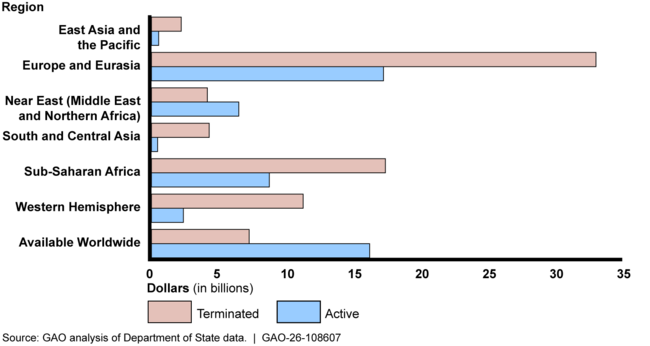
Chart: GAO, GAO-26-108607
How USAID was closed
The closure moved fast. In March 2025 Secretary of State Marco Rubio said 83% of USAID’s programs would be canceled. Later that month State told Congress it would dissolve the agency. On July 1, 2025, USAID stopped carrying out foreign assistance, and what remained moved to State.
Congress then cut the money. The Rescissions Act of 2025, signed in July 2025, canceled about $9 billion, including $7.9 billion of foreign aid. A proposed cut to PEPFAR, the HIV program, was removed before passage. In September 2025 the Supreme Court let the administration withhold about $4 billion more through a pocket rescission.
The courts mostly stayed out of the substance. In March 2025 the Supreme Court refused, 5 to 4, to block payments for work already done. Its later rulings allowed the administration to withhold money while litigation continued.
The new budget
Congress has kept funding foreign aid, at lower levels. The fiscal 2026 national security and State Department bill provided about $50 billion, 16% less than fiscal 2025. Global health got $9.4 billion, close to the year before.
For fiscal 2027 the administration asked for $37.8 billion, a 27% cut, with global health down to $5.1 billion. The House passed a bill at $47.4 billion, with global health at $8.9 billion. The Senate hasn’t acted, and foreign aid, like the rest of the government, runs on the stopgap to December 11.
A new model for global health
The administration’s replacement for much of USAID’s health work is bilateral. Under an “America First” global health strategy released in September 2025, the US signs compacts with individual countries, which commit to pay more of the cost themselves. By October 8, 2026, 36 countries had signed. The compacts commit about $26.7 billion over 2026 to 2030, with partner countries paying 39%. US funding for those countries is $8.1 billion, about a third, below past levels.
How the US compares
Most rich democracies run development aid through a dedicated agency or a ministry with a development mandate. Britain folded its aid department into the Foreign Office in 2020. The US has now gone further. Germany and Japan keep separate development bodies.
What has changed in Washington is the structure: fewer programs, run by diplomats instead of development specialists, with more of the cost pushed to recipients. GAO’s report shows the transition happened without documented criteria for what to keep. Its recommendations are the first step toward writing them down.